Your Source for Electronic Repair and Hobby Information
My First
Tesla Coil
The first component I acquired was the high
voltage capacitor. I found this quite by accident! After having two RCA
high voltage splitters go bad, I decided to destroy one with a sledge
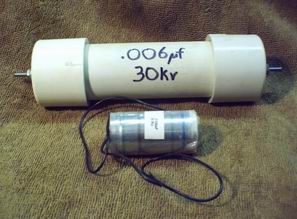
hammer. Inside, I found a rolled capacitor labeled .006mf / 30kv - exactly
what I had been looking for!
I sealed the actual
capacitor inside a piece of PVC pipe filled with silicone sealant. Two
bolts provide connections to the capacitor.
Then I needed to wind my secondary coil -
the most recognizable part of a Tesla Coil.
I'm not sure if I'm more proud of the coil or
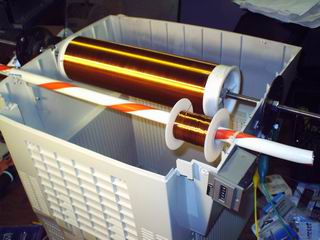
the device that I had to build to wind the coil. For the frame, I used the
back of a computer monitor. A Power Wheels geared drive motor turns the
coil form. To keep track of the number of turns I've wound, I made a disc
with a notch cut out to interrupt an optical sensor which triggered the
counter from a photocopier. And for the final touch, a plastic candy cane
serves to hold the magnet wire feed spool.
Next I needed something to load the secondary with. Not being made of
money, I can't afford a spun aluminum torroid, so I'm going to have to
improvise.
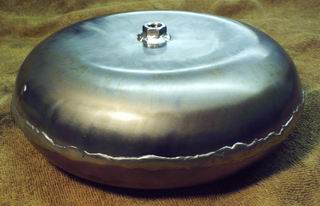
I bought two frying pans from my local dollar store, ground the handles
off and soldered the two pans together. I soldered a nut to one of them to
make the top load easily interchangeable.
I was going to weld the pieces together instead of soldering them, but
the wire welder I have kept blowing holes through the thin metal. A 140
watt soldering gun and a little rosin did the trick.
The only thing about this that bothers me is the ridge where the solder
is. Since solder only goes surface deep, I couldn't grind that down
smooth. I'm hoping it doesn't affect the coil any.
I will post updates as my progress continues...
For
an EXCELLENT set of plans on building your own Tesla Coil, click
here. For a copy
of the safety precautions you should be aware of when building or working with a
Tesla Coil (or any other high voltage project), click
here.



 For
an EXCELLENT set of plans on building your own Tesla Coil,
For
an EXCELLENT set of plans on building your own Tesla Coil,